
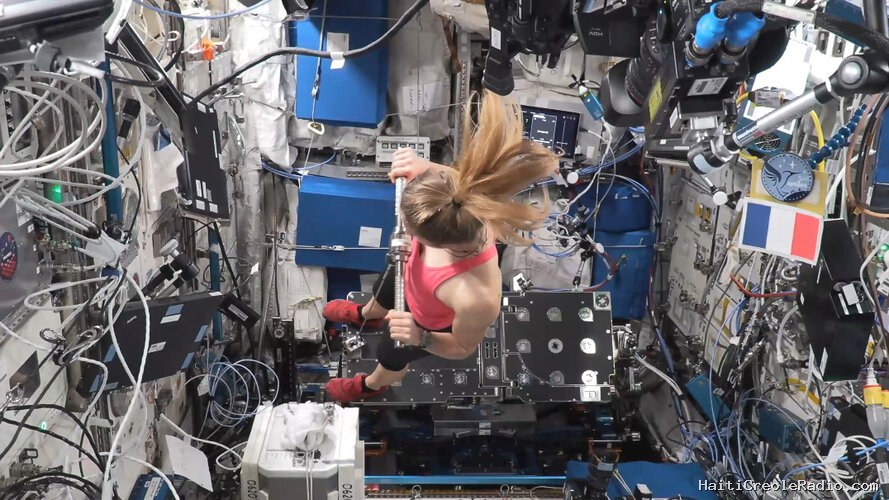
ESA astronaut Sophie Adenot has begun testing the European Enhanced Exploration Exercise Device (E4D) on the International Space Station. Installed inside ESA's Columbus laboratory, the new exercise system will spend the next two years helping researchers evaluate innovative ways to keep astronauts healthy during long-duration space missions.
Following its checkout and activation by Sophie in space, crews will be evaluating the device's design, operational performance and effectiveness in counteracting the physical deconditioning caused by life in microgravity.


Access the video
E4D combines resistive training, cycling, rowing and rope pulling in a single compact device. Supporting more than 30 strength exercises and numerous variations, it offers astronauts a broader range of workouts while taking up less space than traditional exercise equipment.
First rope-pulling exercise in space
Among the first exercises tested was rope pulling – a type of workout never before performed in space. The exercise targets upper-body muscles used in pulling and stabilisation movements, expanding the range of exercises available on the Station.
"I love exercising; it's always been an extremely important part of my daily routine, and it is exciting to add some variety to the on-orbit workouts," said Sophie after activating the system during her εpsilon mission.

Access the video
Expanding exercise capabilities in orbit
Exercise is a vital part of daily life in orbit. Without the constant pull of gravity that normally stimulates muscles, astronauts quickly experience physiological deconditioning that can affect their health, performance and safety on the International Space Station. Daily exercise sessions of approximately 90 minutes on devices such as the T2 treadmill, the CEVIS bike or the ARED weight‑lifting machine are the most effective countermeasures currently available.
Although these machines are effective, they also have limitations. To expand the Station's exercise capabilities and prepare for the needs of future exploration missions, ESA commissioned the development of E4D, developed by the Danish Aerospace Company, alongside NASA's Vibration Isolation System.
Preparing for future exploration
During the demonstration stage, astronauts will progressively evaluate the different functions of E4D. Future phases of testing will also assess its integrated motion-capture system, designed to help astronauts track their performance and correct posture in real time. This built‑in capability aims to reduce reliance on ground supervision and supportsafe, precise and effective training in orbit.
The main goal of the E4D technology demonstration is to gather engineering data and crew feedback to assess whether a single compact device can provide many of the exercise benefits currently delivered by multiple systems on the Station. The lessons learned from E4D will help guide the development of next-generation exercise technologies for exploration missions beyond low Earth orbit.


Commentaires (0)
Laisser un commentaire
Aucun commentaire. Soyez le premier !