
(Français)
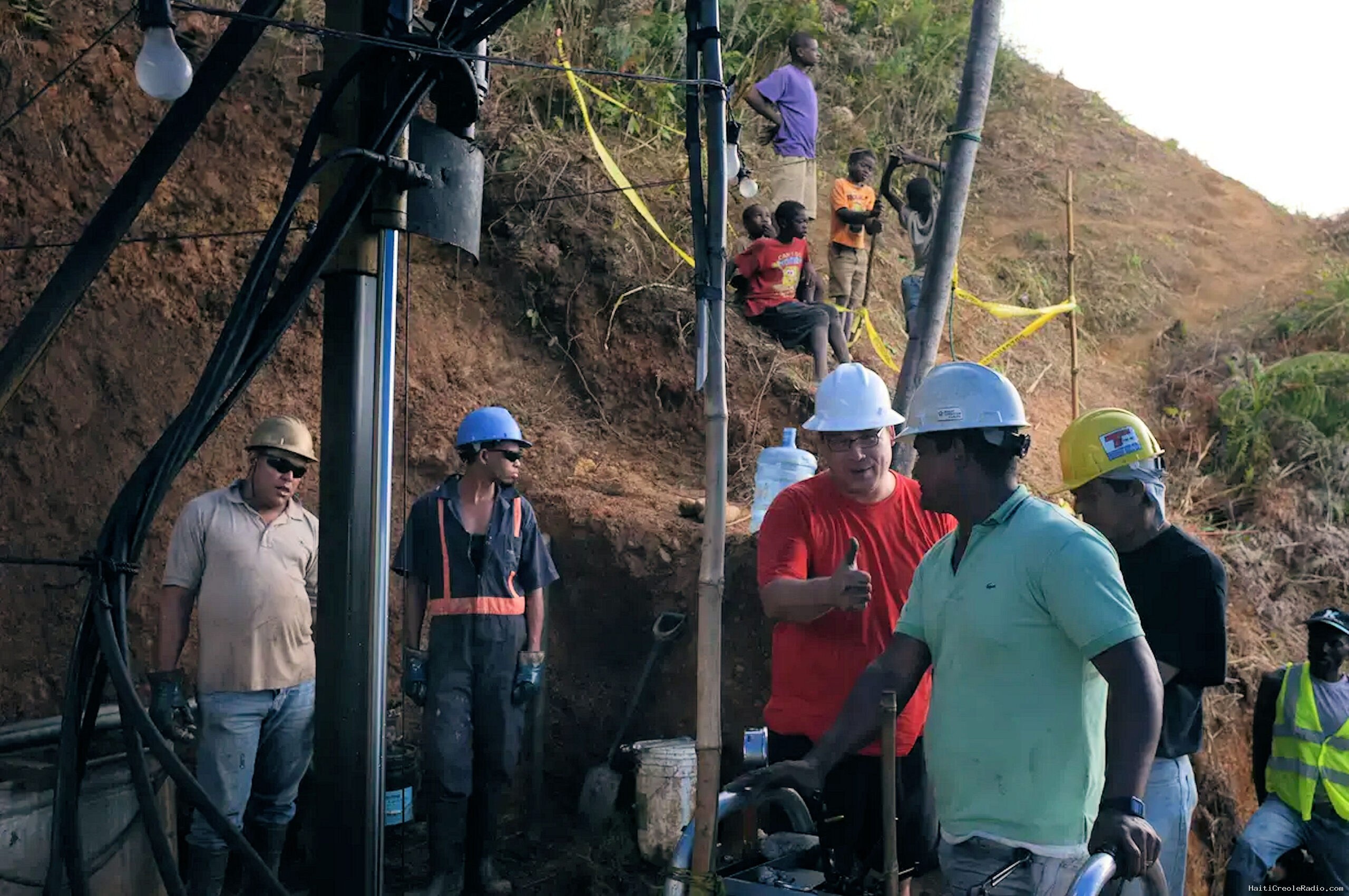
In late March, Haiti’s U.S.-installed de facto Prime Minister Alix Didier Fils-Aimé issued a mining decree that opened the nation’s mineral resources to exploitation by foreign companies.
For decades, U.S. and Canadian mining firms, along with their handmaidens in Haiti’s comprador bourgeoisie and political elite, have been maneuvering for this moment to get their hands on some $20 billion worth of gold dust in Haiti’s northern mountain chains as well as other precious minerals.
The decree, published on Mar. 30, 2026 in Haiti’s journal of record, Le Moniteur, provides the illusion of a legal framework for exploiting Haiti’s mineral resources that is very favorable to foreign capitalists.
Signed by Fils-Aimé’s Council of Ministers, the decree was written and published without any public discussion nor even consultation with the now defunct Pacte National, a collection of political parties which rubberstamped a proposal to bestow upon Fils-Aimé the executive powers of both Prime Minister and President, which are constitutionally supposed to be separate.
The intellectual authors of this plan to consolidate all power in the hands of one unelected, unaccountable man was a cabal of Haiti’s most powerful business oligarchs known as the Institut Macaya, for which Fils-Aimé is the front-man.
Washington’s Return to Gunboat Diplomacy
On Feb. 3, 2026, three U.S. warships – the USS Stockdale, USCGC Stone, and USCGC Diligence – entered the Bay of Port-au-Prince. Their presence served a dual purpose.
First, it established that Haiti was among the targets of Operation Southern Spear. This U.S. military operation, launched last September, has to date extrajudicially blown up 66 small boats and murdered some 215 people, accusing them of drug smuggling to the U.S.. The Pentagon has provided absolutely no evidence that the victims of the deadly boat strikes are what it calls “narco-terrorists.” Most facts point to them being fishermen, commuting workers, or travelers. In addition, experts say these strikes have made “barely a dent in the flow of narcotics” and have “been a gift to the cartels by impeding international cooperation to combat drug trafficking.”
Secondly, the three warships’ presence was meant to warn the outgoing Transitional Presidential Council (CPT), whose mandate expired on Feb. 7, to not interfere with the transfer of power to Fils-Aimé’s de facto government. A few weeks prior, the U.S. Chargé d’affaires Henry Wooster said that it was “essential” that Fils-Aimé, whom the CPT had named to the post, remain in power. Some CPT members had been holding meetings and maneuvering to form a new presidential council and to have Fils-Aimé replaced. But Wooster’s comments, and the warships, made it clear that Fils-Aimé would be Washington’s chosen puppet.
The attempt to replace Fils-Aimé was notably opposed by CPT member Laurent Saint-Cyr, who represented Haiti’s business elite on the council (the other six voting members all represented political parties and coalitions). The alliance of Fils-Aimé with Saint-Cyr (the CPT’s last rotating president) was widely regarded as representing a takeover of Haiti’s transitional, de facto government by Haiti’s private sector.
Backed by the gunboats, Fils-Aimé seized power on Feb. 7, despite CPT opposition. But even the Trump administration, which shows little regard for appearances or the law, agreed that some semblance of civic approbation was worthwhile.
The “National Pact for Stability and the Organization of Elections (Pacte National)” was signed following closed-door negotiations on Feb. 21–22 at the Hotel Ritz Kinam in Pétion-Ville. It effectively consolidated all executive power in Fils-Aimé’s hands, making him both the head of State and the head of government.
This farcical weekend conference put make-up on a Feb. 9 decree illegitimately declaring that Fils-Aimé alone would exercise executive power aided by a Council of Ministers (whose posts and fat salaries went to members of the parties supporting the Pacte National). Fanmi Lavalas of former President Jean-Bertrand Aristide, the Parti Haïtien Tèt Kale (PHTK) of former President Michel Martelly, former interim Prime Minister Claude Joseph’s EDE, former Prime Minister Ariel Henry’s December 21 Accord, and the platform Democratic Resistance (RED) of Renald Lubérice, a former Jovenel Moïse advisor, were among the first six signatories.
Other signatories include political coalitions such as COPPOS-Haiti, KOREPAD, and the Montana Accord. The O-News 1ère website provides a complete list of the Pacte National signatories.
The Institut Macaya gets its wish
The Pacte National signatories approved an objective set forth by the Institut Macaya almost two years ago: to consolidate the power of the President, who represents the State, with the power of the Prime-Minister, who runs the government.
They first tried to accomplish this through rewriting Haiti’s 1987 Constitution. However, in early October 2025, after a contentious, drawn-out process involving several opposing sectors, Haiti’s de facto government shelved its attempt to rewrite the constitution.
An analysis by The Canada Files showed that key constitutional amendments proposed by the government’s Steering Committee for the National Conference, which subsequently organized a Working Group on the Constitution tasked with producing a draft of these proposed reforms, had been virtually copy-pasted from an earlier draft constitution written by the Institut Macaya.
The Institut Macaya was founded by Reuven Bigio, son of Haiti’s wealthiest oligarch, Gilbert Bigio (who is also Israel’s honorary consul). Macaya’s members include other oligarchs such as Jean Luc Vorbe, Philippe Coles, and Joel Bonnefil.
Fils-Aimé has close ties to Macaya. Researcher Jake Johnston revealed last summer that Fils-Aimé, before becoming Prime Minster, sat on the board of Banque d’Union Haitienne (BUH) along with other Macaya members Christopher Handal and Olivier Barreau, who was BUH’s head at the time.
Barreau is now CEO of the Alternative Insurance Company, where he employed former CPT member Saint-Cyr, underlining the close relationships between Haiti’s oligarchs and halls of power.
According to Johnston, Barreau stepped down from Institut Macaya soon after its founding and “is expected to be a [Presidential] candidate whenever an election is eventually held.”
Beyond running a presidential candidate drawn from Institut Macaya, the intent of amending Haiti’s constitution was to centralize all power in the hands of an easily controlled PM/President, which would facilitate passing legislation beneficial to Haiti’s oligarchs and political elite. This includes opening Haiti’s mineral resources to exploitation by foreign mining companies.
Another Gold Rush in Haiti
Although the Spaniards mined much of Haiti’s huge mineral wealth using enslaved Taino native Americans after Columbus landed in 1492, Haiti still has an estimated $20 billion worth of residual gold in its mountains along with large deposits of silver and copper.
When President Michel Martelly came to power in 2011, declaring that Haiti was “open for business,” Canadian andAmerican mining companies finally thought that they’d have their chance.
Martelly’s Prime Minister Laurent Lamothe brought in World Bank representatives as well as North American mining representatives to consult on proposed constitutional reforms, which were ultimately blocked by Haiti’s Senate in 2013.
Fils-Aimé’s decree provides royalties of 4% on gold, 3.5% on copper and nickel, and 5% on precious stones.
The “consultants” had worked to formalize a 10-year confidentiality period for any “reports, documents and data pertaining to… work undertaken within the context of a mining title”. This included geological discoveries or topographical information gleaned in the course of mining operations.
This 10-year confidentiality period was finally established by Fils-Aimé’s illegitimate decree.
Article 115 of the new Mining Decree states that “All reports, documents, and data relating to the results of work carried out under a Mining Title shall remain confidential for a period of ten (10) years after their filing.”
“These reports, documents, and data may not be made public” by the Mining Authority during the aforementioned ten year period “without the written consent of the title holder”, the Decree explains.
This means that foreign mining companies can withhold all information regarding the discovery of mineral resources in Haiti from the public for up to 10 years.
A Mining Decree with outrageous terms
The Mining Decree also specifies the royalties which the state will collect for different minerals, precious metals, and precious stones on the basis of current world prices or the London Metal exchange rates.
The decree provides royalties of 4% on gold, 3.5% on copper and nickel, and 5% on precious stones.
These royalties are much lower than those fixed by countries in the Alliance of Sahel States (AES), which are successfully using income from precious metal royalties and other minerals to build infrastructure and fund projects that benefit the population.
For example, Mali and Burkina Faso instituted new Mining Codes that allow for 6% royalties when gold sells over $1,600 per ounce and 7% when it exceeds $2,500 per ounce, and then to increase as market value rises. Gold now sells at over $4,000 per ounce on the spot market.
In 2023, Mali’s Council of Ministers also approved the government’s plan to expand state and local ownership in mining projects to up to 35%, providing for other streams of revenue from mineral resources.
Haiti’s Mining Decree does not mention state or local ownership of future projects.
Mali also limits exploration contracts with foreign mining companies to 3-9 years, with the possibility to renew. According to Article 57 of Haiti’s Mining Decree, permits are awarded for a maximum duration of 25 years, with an option to renew for periods of 10 years. In short, Fils-Aimé’s decree would produce far less revenue per capita than compared to AES states.
Meanwhile, Haiti desperately needs large investments in infrastructure, healthcare, access to potable water, sanitation, and education, as the leader of the Viv Ansanm (Live Together) armed group coalition, Jimmy “Barbecue” Cherizier, has demanded since 2020. However, Fils-Aimé, who is trying to crush the Viv Ansanm movement, is asking for significantly lower royalties than other countries, reducing the amount of tax revenue to invest in projects to help Haiti’s desperately poor. But large mining companies based in Canada, the U.S., and Australia will greatly benefit.
Corporate plunder enforced by foreign mercenaries
One might not be surprised that Martelly’s PHTK was part of the Pacte National that has enabled Fils-Aimé to issue this decree. But Aristide’s Fanmi Lavalas, once in the vanguard of democracy in Haiti, has also shown strong support for Fils-Aimé. The party has moved sharply to the right, repeatedly supporting imperialist policies and “transitional governments” imposed by the U.S., Canada, and their reactionary Latin American allies, recently organized by Trump into an alliance called the “Shield of Americas.”
By supporting Fils-Aimé’s de facto government, these parties are also endorsing its “security strategy.” This amounts to a murderous and under-reported war against the residents of poor neighborhoods controlled by the armed groups that make up the Viv Ansanm. This war has resulted in many massacres of civilians, including dozens of children. The war is being waged by the Haitian National Police (PNH), their associated paramilitary “brigades,” and Erik Prince’s mercenaries, whose specialty is an explosive drone campaign.
Contrary to some “human rights” reports, the cops, paramilitaries, and mercenaries mostly kill civilians, and it appears that most of the innocent civilian casualties die at their hands.
The terror of the explosive drone campaign combined with the PNH’s persistent violence towards the public are one factor preventing the popular neighborhoods in Port-au-Prince from cooperating and forming political movements that represent their interests. The paramilitary brigades also play a significant role in dividing Haiti’s capital and preventing neighborhoods from coexisting peacefully and collaborating.
In a recent interview with journalist Kim Ives, journalist/podcast host Max Louissaint (known online as Ralph Laurent) explained that bourgeois-backed paramilitary brigades play a crucial role in fragmenting popular neighborhoods and maintaining antagonisms between armed groups, while supporting violence perpetrated by the PNH and Vectus Global.
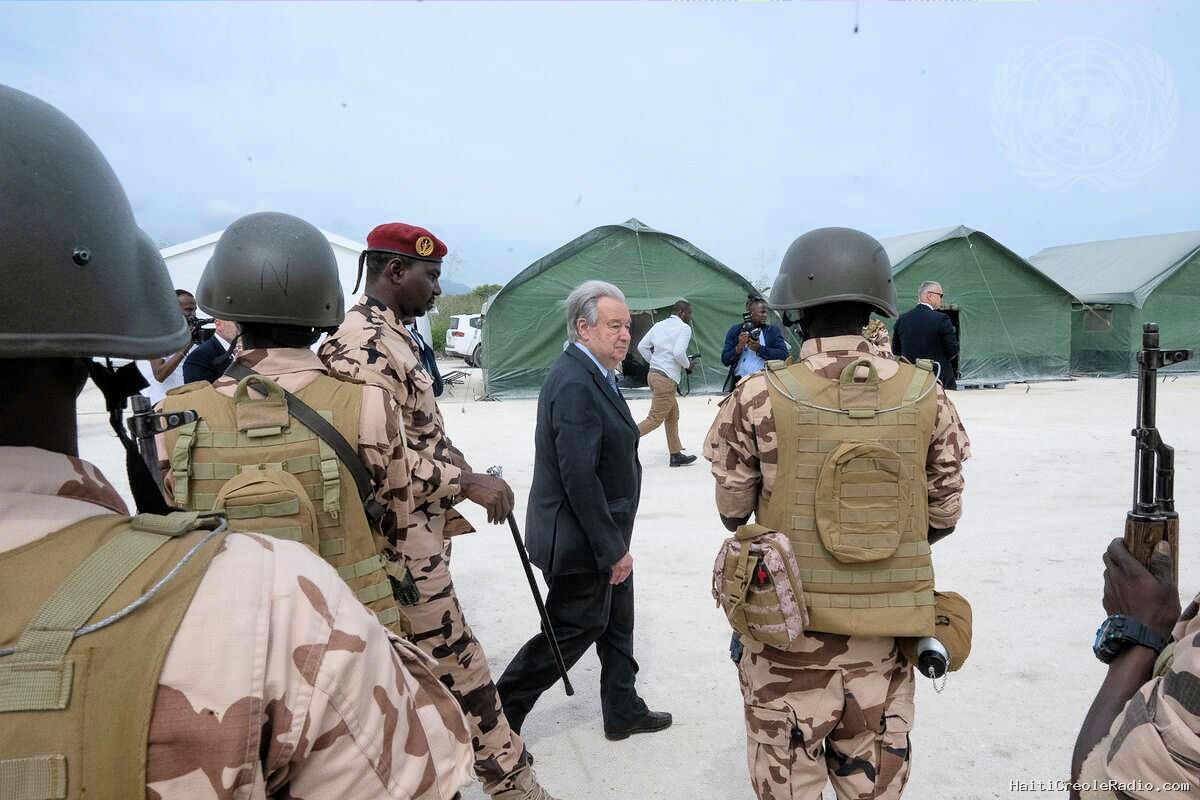
Meanwhile, Fils-Aimé has allowed the U.S. military to begin occupying Haiti as part of Operation Southern Spear, first through taking control of Haiti’s main airport in Port-au-Prince, followed by the arrival of U.S. soldiers in Ouanaminthe.
The Haitian people want dialogue
Fils-Aimé has also adopted the U.S. government’s propaganda which labels Viv Ansanm as a “terrorist group.” This label is designed specifically to curtail any attempts at dialogue with neighborhood armed groups, although negotiations with them are supported by a growing number of Haitians to resolve the security crisis.
The desire for dialogue and reconciliation with armed groups is held by other sectors of society as well. In January, several thousand held an interfaith march with a message: “Haiti cannot hope for a better future without dialogue, unity, and reconciliation.” The call for dialogue is also supported by Haitian academics, international figures, and Pan African leaders.
The desire for dialogue is gaining popularity among the citizens of Port-au-Prince
The recently appointed mayor of Cité-Soleil, Daniel St-Hilaire, has also called for dialogue with armed groups. He confirmed that the municipal commission is already working on organizing a broader dialogue involving the various sectors of the sprawling shanty town.
The desire for dialogue is gaining popularity among the citizens of Port-au-Prince as well. A recent report by the Institut de Recherche et d’Action pour la Paix (IRAP) found that over half of the 523 Haitians interviewed expressed an interest in opening channels for dialogue with armed actors. Haitians living in popular neighborhoods are more inclined to support dialogue, while internally displaced persons were more likely to be opposed.
The two primary reasons that many Haitians supported dialogue were “necessity due to weak security apparatus” and “exhaustion,” as the population can’t withstand more violence.
Women and girls in Port-au-Prince reportedly face extremely high levels of sexual violence. A recent report by Médecins Sans Frontières (MSF) shows that since 2022, “among the survivors who received care at the MSF Clinic in Pran Men’m, “57% were attacked by members of armed groups, often through group assault committed by multiple perpetrators.” The armed groups are not identified in the report, so one does not know if the sexual violence perpetrators are from neighborhoods controlled by government-linked paramilitary brigades or those controlled by Viv Ansanm.
The IRAP report explains that many residents of neighborhoods controlled by Viv Ansanm believe the PNH “considers them as legitimate targets” and fear relocating because of “fear of vigilante justice.”
Importantly, the report also explained that armed actors, primarily members of PNH-organized paramilitary brigades, report a “sensation of being trapped in a vicious cycle of bloody violence; living under constant threat and unable to trust anyone.” This results in “extreme stress, fear, trauma; deep feelings of guilt and shame.”
This provides some hope that the leaders of armed groups in Viv Ansanm and the leaders of paramilitary brigades, like the one led by Samuel Joasil in Canapé-Vert, will begin engaging in serious dialogue and eventually collaboration.
Cherizier has repeatedly called for dialogue and deplored the violence permeating Port-au-Prince. “If you are nationalists, what’s happening should revolt you”, he said one year ago in a video post on Jul. 5, 2025. “Let’s unite and write history.”
“The only thing that can extract Haiti from the hole it is in right now is dialogue,” Cherizier said in March 2025. “Let us talk to each other and explain what we need.”
Travis Ross is based in Montreal, Québec. He is also the co-editor of the Canada–Haiti Information Project. Travis has written for Haiti Liberté, Black Agenda Report, The Canada Files, and TruthOut. All his articles are collected on Substack. He can be reached on X.
Commentaires (0)
Laisser un commentaire
Aucun commentaire. Soyez le premier !